How Australia protects old wealth and forgets new workers
by Bob Wilson, COFA Committee
This month, I read two articles that left me thinking about two very different kinds of invisibility. The first is the hidden wealth of a million trusts tucked inside this country’s financial architecture — a $3.1 trillion arrangement that, as one commentator put it, “beggars belief” in its purpose. The second is the invisible poverty of a young Afghan man I’ll call Mohammad, who has spent the past two years in a bare Housing Trust flat in Adelaide, sending nearly every dollar he earns back to two families — both on the other side of the world, one waiting on a visa. Both kinds of invisibility are deliberate. One takes expensive legal advice to construct. The other costs nothing, because nobody told Mohammad (not his real name) there was any other way.
The SBS piece I stumbled across while scrolling through my morning news feed explained how discretionary trusts — the family trust variety — allow wealthy Australians to distribute income across beneficiaries who happen to occupy lower tax brackets: a couple, three non-working adult children, perhaps a niece or nephew for good measure. The trustee decides each year who gets what, steered by whoever has the most favourable “tax profile” — which typically means whoever earns the least.
This opaque system has doubled in size in twenty years. It is perfectly legal, extraordinarily popular among those with assets to protect — rental income, share portfolios, family businesses — and until now, essentially invisible to most of us. Babies, the article noted with something approaching dark comedy, can receive distributions from testamentary trusts and claim the adult tax-free threshold — a concession, as one law professor observed, on behalf of a great-great-grandparent the infant never met.
Babies as tax instruments. You have to admire the creativity, if admire is quite the right word.
Mohammad is twenty-nine. He drives a truck during the week and an Uber on weekends, still paying off the car. He met the truck’s Pakistani owner at his mosque, which is how these things often begin — someone from the community, someone who speaks your language, someone who seems to know how things work here.
The owner suggested he come and drive for him; register as a sole trader and get an ABN from the tax office — “better for both of us.” What was not mentioned — what is rarely mentioned — is that the ABN arrangement strips away sick leave, annual leave, and superannuation. No safety net. No accumulating retirement savings. Just a flat payment and the illusion of independence. For new arrivals from countries where worker protections are unheard of, and where informal arrangements are simply how the world works, there is no reason to suspect the offer is anything other than generous.
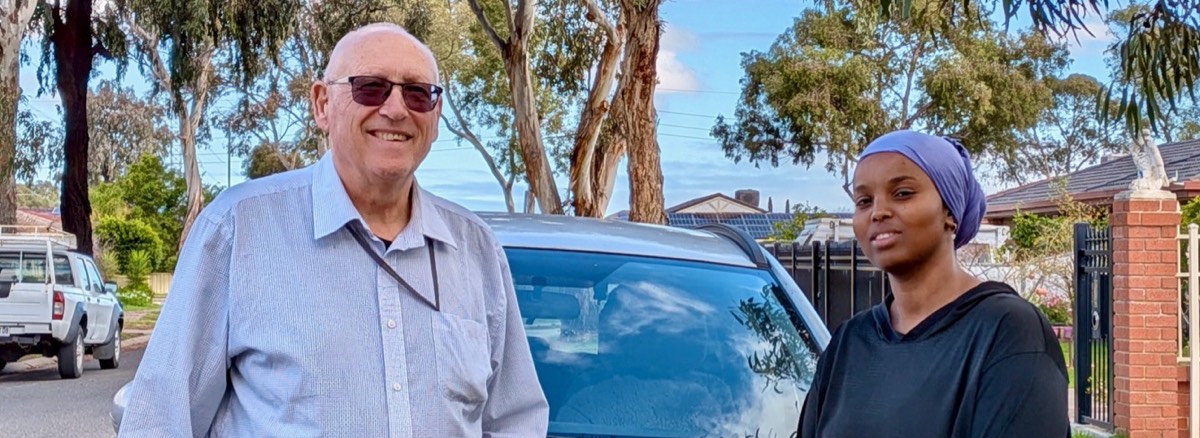
So this month, we joined Mohammad and his wife, Fatima, to welcome her arrival in Adelaide. We knew she had spent two years teaching herself English online while waiting for her visa — two years of patient, determined study in a country where formal education for women is banned. She was preparing for a life she could only imagine.
Her smile and her spoken English were remarkable. Far ahead of Mohammad’s, if truth be told. He had long since abandoned his free TAFE English classes, deciding that working seven days a week was the only option available to him.
Judi and I met them at a restaurant for dinner. We talked about the flight, her family at home, first impressions of the city. She asked about schools, about the neighbourhood, about whether there was a library nearby. She had plans. Later in the week, we helped her navigate her first encounters with Australian bureaucracy — Medicare, a bank account, the paperwork that comes with beginning.
We then dropped her at their community housing unit, and she invited us in for the first time. The flat stopped us both in our tracks.
It was bare in the way that takes a moment to fully register. A thin mattress. A small table. Almost no furniture to speak of. Not the set-up of someone who hasn’t had time to settle in — the set-up of someone who made a decision, every week for two years, to send the money home instead. Two families supported on the wages of a man working seven days, sleeping on a mattress, eating simply, asking for nothing.
I confess I felt something uncomfortably close to shame. I had helped Mohammad with his documents. I had followed Fatima’s visa application through every frustrating bureaucratic turn. What I had never done — not once — was sit down and ask him how he was being paid.
I know that the people who design and use family trusts are not villains. Most are doing what their accountants recommend, operating within rules that successive governments have chosen not to change — until, perhaps, now. The Albanese government has announced a thirty per cent minimum tax on discretionary trust income from 2028. A furore that has dominated the news cycle for days. The Australia Institute cautiously welcomed the change. Several accounting bodies promptly described it as “disruptive.” The right-wing shock jocks declared it the end of civilisation as we know it.
The arguments, as always, are complex. Farmers use trusts. Small businesses use them. The line between legitimate succession planning and systematic tax minimisation is not always crisp.
But here is what is now plain. The wealthiest ten per cent of Australian households hold more than ninety per cent of private trust wealth. And the workers least likely to benefit — wage earners, casuals, those paid through informal arrangements — are also the workers most vulnerable to being told, by someone they think they can trust, that an ABN is the smart move.
What troubles me most is that the community connectors — I don’t know what else to call them — are themselves often migrants who found a foothold early and now pass on what they learned, or what suits them. Their message is dressed as opportunity: become your own boss, minimise your tax, take control. What it omits is the dismantling of protections that took Australian workers generations to win. Sick leave. Annual leave. Super. These are not perks. They are the floor beneath everything else.
Mohammad didn’t know there was a floor. He was living on bare boards, quite literally, while someone else quietly removed it.
Fatima moved through that sparse flat with a quiet dignity that made me want to look away from my own discomfort. We made offers of help with furniture. She had plans. She was already, in the best possible sense, arriving.
I made a mental note — more than a note, a commitment. When the time is right, I will sit down properly with Mohammad and talk through his working arrangements. What he’s owed, what he’s entitled to, and what it would take to move him from conveniently contracted to properly employed. It is, I’m aware, a conversation I should have had two years ago.
Australia has a million trusts and a system for protecting the wealth of people who already have it. It has rather fewer systems for protecting the wages of people who are earning it for the very first time, in a country that can be generous or exploitative depending, largely, on who greets you at the door.
Mohammad was greeted at his mosque — or it could just as easily have been a neighbourhood church. I hope that, in some small way, we can do better by him now.